Where will growth come from for developing countries in the next few decades?
Many new opportunities are emerging (thanks to AI) that are particularly exciting for countries like South Africa.


In a fascinating report written by Prof Jeffery Sachs (Columbia University) for the The Future Investment Initiative (FII) Institute - the argument is made that artificial intelligence is rapidly changing development pathways for developing economies and will more than likely move the driver of economic growth away from the traditional low-cost manufacturing labour models, towards higher productivity industries, stronger human capital, and faster expansion in services.
Thanks to automation - the old development model of 'sweating cheap labour in factories to supply cheap goods for the global value chain' is no longer as commercially viable as it used to be.
But in it's place many new opportunities are emerging that are particularly exciting for countries like South Africa.
Where do the opportunities lie over the next few decades?
Construction
'In many African EMDEs, construction will likely be the single largest employment absorber for the next twenty years. Rapid urbanization will create enormous demands for housing, sanitation infrastructure, transport systems, public buildings, and urban energy distribution. Construction will be highly resistant to automation because it is site-specific, involves highly variable conditions, and requires physical dexterity in unpredictable environments. Modular construction with local materials can improve productivity without eliminating labour demand.'
Healthcare
'Healthcare in Africa will require massive scale-up: community health workers, nurses, technicians, laboratory staff, and support personnel. AI will augment their effectiveness but does not replace them. The binding constraints on healthcare employment will be public financing and training, not technology.'
Education
'The scale-up of quality education in Africa will similarly require a massive teacher recruitment even with AI-powered adaptive learning platforms. Teachers will remain essential even in AI-empowered and online learning environments.'
Proximity-based manufacturing
'Resource-based manufacturing, where proximity to raw materials confers a comparative advantage, will not only continue but will be substantially enhanced by AI. Advanced steel production (e.g. stainless steel and other specialty steels), battery manufacturing using locally mined lithium and cobalt, rare-earth processing, agroprocessing, the production of green hydrogen and advanced biofuels, are capital-intensive, resource-proximity-driven activities where AI will help to optimize production processes, quality control, and supply-chain management. Local processing of primary commodities will become financially viable with AI-optimized production. These activities will create some good jobs, but mostly will create foreign exchange earnings.'
Then the report pays particular attention to the opportunity offered by the creative economy and what it could unlock for developing economies.
The creative economy
'The creative economy, including music, film, fashion, visual arts, design, cuisine, and other cultural industries, will be a major sector for new employment and export. It is skill-based, labour-intensive, rooted in geography and culture, and increasingly enhanced rather than displaced by AI. For EMDEs, the creative economy represents an extraordinary opportunity for export-led growth and mass employment.'
'AI in lower-income settings can amplify the creative producers rather than displacing them. AI tools for production (generative design, video editing, sound design, colour grading, animation) will dramatically lower the costs of entry and speed up production.'
'These are skill-based, labour-intensive, geographically rooted industries. You cannot outsource music production from Lagos to another country. You cannot easily move a film industry from Bollywood to another location. The creative economy is rooted in place and culture.16 It requires education and training in the specific skills of creative production. But it does not require high capital costs in the way that manufacturing does. It does not require scarce natural resources. It does not require large-scale infrastructure. It requires talent, skill, some equipment, and platforms to reach global audiences.'
'For EMDEs, the opportunities are immense. Every country has musicians, filmmakers, fashion designers, and artists. Digital platforms, including YouTube, TikTok, Spotify, Netflix, Amazon Prime, and Instagram, provide direct access to billions of potential customers globally. The barrier to entry has collapsed. A filmmaker in Lagos can distribute globally at near-zero cost. A musician in Nairobi can reach listeners worldwide through Spotify. A fashion designer in Manila can sell internationally through e-commerce platforms. A musician in Latin America can use AI-empowered mastering and production tools to achieve studio-quality sound at a tiny fraction of the cost. The main requirement now is the skill and the cultural capital to create something audiences want to consume, and these skills and cultural capital are in ample supply.'
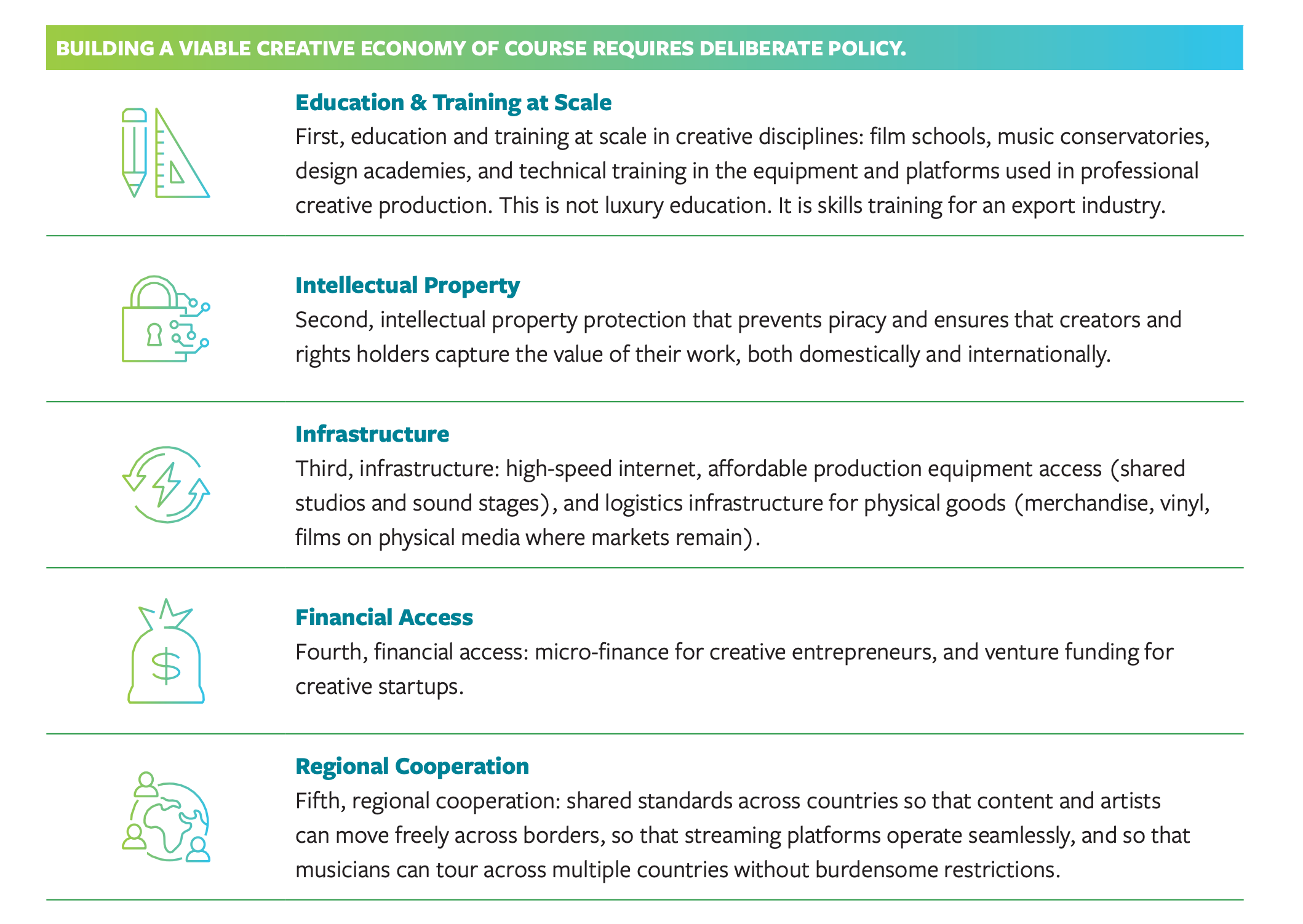
The best investment developing governments can make to enable these opportunities?
'AI-led development will require skilled workers across the economy, not only to manage AI systems in agriculture, mining and manufacturing, but to support skill-based employment in the service economy. For this reason, quality education will be the single highest-return investment for long-term development. The relationship between human capital and GDP per capita across countries is tight and wellestablished.17 Education raises individual productivity (with a Mincer coefficient of approximately 0.12, implying that each additional year of schooling raises earnings by about 12 percent, but of course the gains are quality dependent), induces higher business investment as firms respond to a more skilled workforce, boosts economy-wide total factor productivity through technology adoption and innovation, accelerates the demographic transition to lower fertility, improves governance, and enhances lifelong health.'
'AI can help to lower educational costs per student, raise educational quality, support teacher training, and narrow the gaps in educational outcomes between students in high income and low-income households. AI-powered adaptive learning platforms can personalize instruction at scale and in local languages, substantially raising the effectiveness of each teacher. Teachers, of course, will remain essential for classroom management, motivation, socialization, and the irreplaceable human dimension of education.
The implication is that massive teacher recruitment and training will be needed even with AI augmentation. Education is therefore a major employment sector as well as a productivity investment. Digital literacy at scale, not computer science PhDs but practical AI fluency for the entire workforce, is the educational content that matters most for the AI era. A self-financing model for education. Education has an internal rate of return of at least 15 to 20 percent per annum, far above the cost of capital.21 This means that education can be essentially self-financing over the long term if the returns are captured through taxation. The model is straightforward: the state finances education through long-term borrowing; graduates enter the labor market and pay payroll taxes on their enhanced earnings; these tax revenues repay the education debt and fund the next generation of students.'
It is tempting to think that the impact of AI on all economies will be the same, but the context from which developing economies scale is very different from what's happening in more developed parts of the world.
Rather than AI being the eliminator of employment, for countries like South Africa it can most certainty act as an economic accelerator if the productivity gains it offers are coupled with intentional investments in human capital and creativity to produce much-needed export-led growth in tradable sectors.
Rather than the usual doom-and-gloom scenario that's all too often lauded as gospel truth by the blue-rinse brigade, these is also credible evidence to suggest that AI could be a significant game changer 'the Global South'.
More: