
Creating spaces with paper
Paper spaces allow us to stand back and objectively consider things that are 'beyond ourselves'.

Question: 'How do you know when people in a brainstorming workshop are really thinking and getting energised by their ideas?'
You know the energy in the room is starting to escalate when people stand up. move around, talk loudly and gesture wildly with their arms.
Thinking...deep reflective thinking...doesn't in practice really happen while sitting still.
It's actually rather physical.
It also requires lots of tangible elements - big Post-It notes, colourful markers, large format paper etc etc.
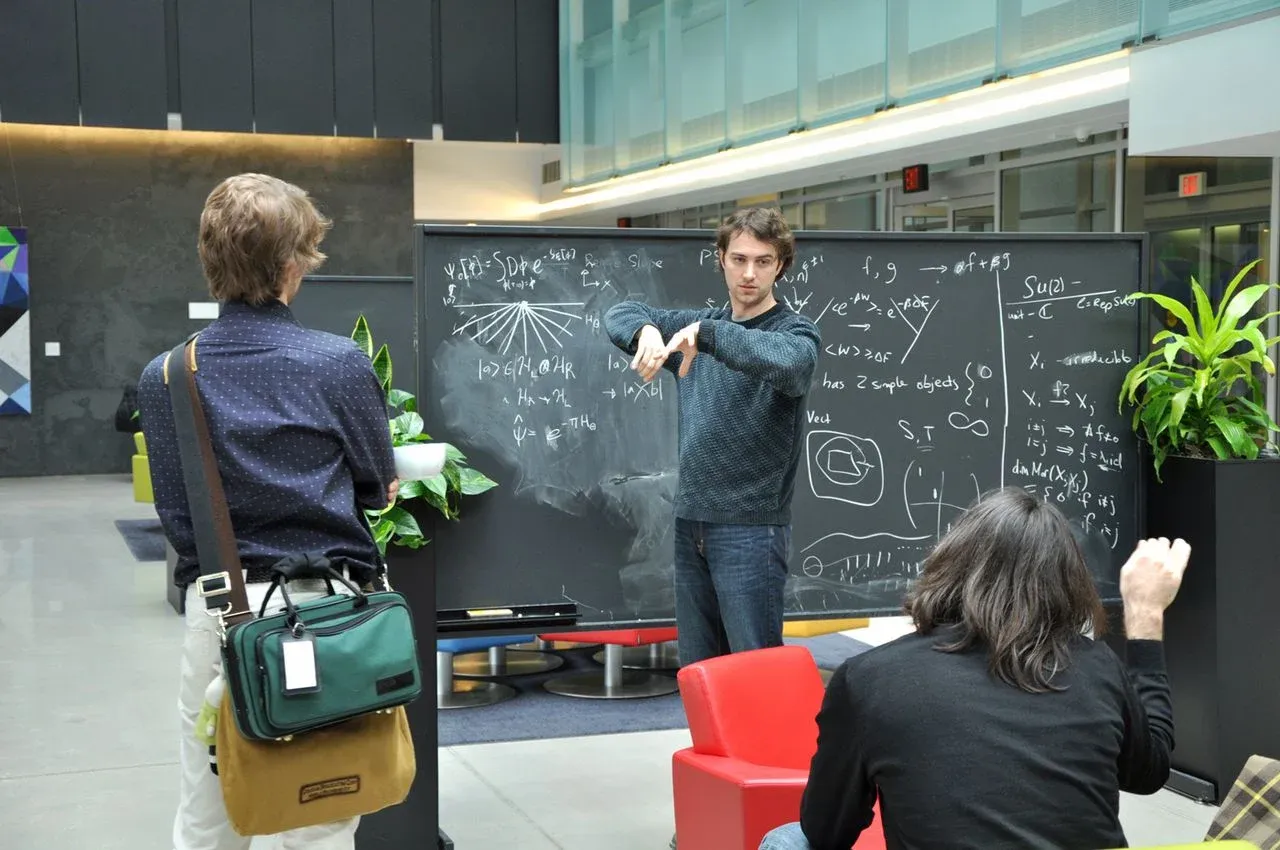
Recently a fascinating study was conducted trying to understand why mathematicians (people who make a living thinking about highly abstract stuff) prefer to do their work on blackboards:
‘Mathematics is all about concepts, logic, proofs, and other things that are abstract and cerebral; and so if any kind of knowledge work could happen independent of place, it would be math.'
Psychologist Shadab Tabatabaeian, a cognitive and information sciences Ph.D., studies embodied cognition in mathematics. In an article she recently published, she suggests:
“the practice of mathematics is almost always a form of manual labor — scribbling, sketching, erasing, gesturing”;“mathematical practice appears to be a
species of physical labor.”
‘That labor happens mainly at blackboards, and the practice is widespread enough for mathematicians to even talk about a specific brand of chalk— Hagoromo’s Fulltouch— the way pianists talk about Steinway.
‘A blackboard lets you write a lot of stuff, then step back and survey what you’ve written. For mathematicians, the blackboard and surrounding workspace becomes like “an ecosystem, with mathematicians actively constructing their own ‘notational niches’ within which they can reason by inscribing (e.g., sketching, writing, erasing), gesturing (e.g., pointing to connect two inscriptions), and looking (e.g., shifting gaze from one inscription to another).'
Mathematicians think with / through their blackboards and chalk, in a similar way as to how workshop participants are able to wrestle with concepts and ideas that are jotted down on sticky notes.
The ideas literally become physical artefacts, which can be examined and prodded without remaining internalised.
Paper spaces
Paper and physical spaces that are tangible (like magazines, printed brochures, catalogues) allow us to better imagine intangible things, like ideas and futures, more effectively as individuals and collectively.
These paper spaces allow us to stand back and objectively consider things that are 'beyond ourselves'. They guide the imagination. They direct our attention through the senses to a singular point of focus.
They allow us to physically move around the idea, looking at it from multiple angles, to immerse ourselves further into the possibilities that might be available.